
Device Information
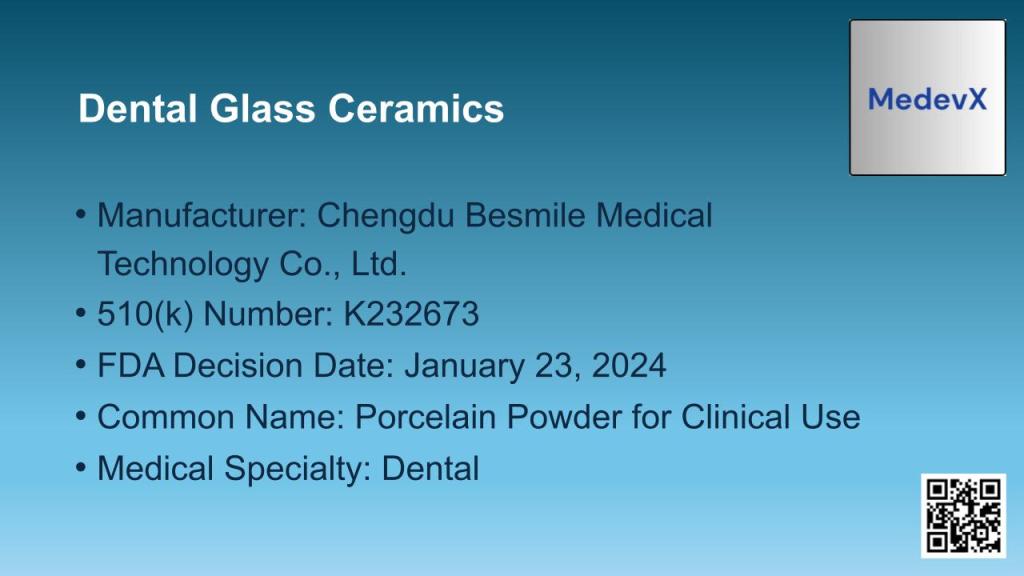
Device Specifications
Dental glass ceramics comprise SiO2, Al2O3, Li2O, and others. These ceramics are designed for high durability, flexural strength over 300 MPa, and low chemical solubility under 100 μg/cm². By mimicking natural teeth, the product offers enhanced aesthetic results.
Indications
Dental Glass Ceramics are indicated for making all-ceramic restorations, including veneers, inlays, onlays, partial crowns, anterior crowns, and posterior crowns. These dental restorations are created using CAD/CAM systems or hot press techniques.
Intended Use
This device is intended for trained professional dentists to fabricate dental restorations for patients with denture defects or missing teeth.
Availability
Prescription Use Only (21 CFR 801 Subpart D).
Contraindications
Not suitable for molar restorations or prostheses involving four or more units.
Study Results
Nonclinical Testing:
The Dental Glass Ceramics were tested for physical properties, including density (≥ 2.2 g/cm³) and flexural strength (≥ 300 MPa). The material composition and processing standards were verified. Biocompatibility tests confirmed the material is non-toxic, non-sensitizing, and non-genotoxic.
Regulatory Information
- Regulation Number: 21 CFR 872.6660
- Regulatory Class: Class II
- Product Code: EIH
- Applicable Regulations: These include general requirements for labeling, good manufacturing practices (21 CFR Part 820), and medical device reporting (21 CFR Part 803).
Manufacturer Information
- Name: Chengdu Besmile Medical Technology Co., Ltd.
- Address: No. 9, Sec. 2, Shengwucheng North Rd., Chengdu Tianfu International Bio-Town, Shuangliu District, Chengdu, Sichuan, 610200, China
- Contact Person: Moushan Liu
Predicate Device Information
- Primary Predicate Device: Dental Lithium Disilicate Glass Ceramic Block (K141727)
- Difference Between Predicate and Current Device: The composition differs slightly, but both use similar main components (e.g., SiO2, Li2O). Both devices share identical uses and safety profiles.
Implications
This device offers enhanced dental restorations that are durable, aesthetically pleasing, and safe. It facilitates advanced dental manufacturing techniques like CAD/CAM.
References
- Dental Glass Ceramics. K232673. Chengdu Besmile Medical Technology Co., Ltd.. FDA Summary Link. https://www.accessdata.fda.gov/scripts/cdrh/cfdocs/cfpmn/pmn.cfm?id=K232673
- https://www.bsmdental.com/
 Medevx