
Device Information
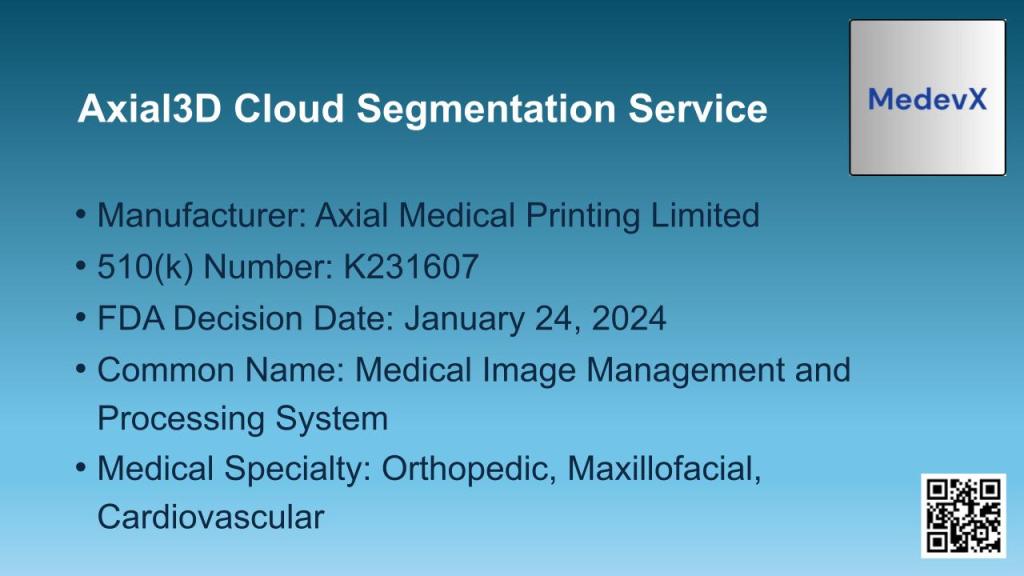
The Axial3D Cloud Segmentation Service is a cloud-based system for processing medical imaging. It enables the transfer of DICOM images to create physical models using 3D printing. These models are used for treatment planning and diagnostic purposes. The service supports applications in orthopedics, maxillofacial, and cardiovascular care for adults and pediatric patients over 12 years old.
Indications
The device processes DICOM images into 3D models for treatment planning and diagnostics. It is suitable for orthopedic, maxillofacial, and cardiovascular care in adults. Cardiovascular applications are also available for children aged 12 to 21 years. It should be used alongside other diagnostic tools and clinical expertise.
Intended Use
The Axial3D service assists healthcare professionals in creating 3D-printed models from Computerized Tomography (CT) and CT Angiography (CTA) images. It is suitable for hospitals and benefits adult and pediatric patients over 12 years old, especially in cardiovascular cases.
Availability
Prescription Status: Prescription use only
Study Results
The device underwent non-clinical testing, including software design verification and validation. The software was tested according to FDA guidelines and successfully met all requirements. Physical models were validated to achieve a measurement accuracy of ±0.7mm when printed with compatible 3D printers.
Regulatory Information
- Regulation Number: 21 CFR 892.2050
- Regulatory Class: II
- Product Code: LLZ
- Additional Regulation Requirements: The device complies with 21 CFR Parts 800-898, Quality System regulations (21 CFR Part 820), and software validation standards per FDA guidance.
Manufacturer Information
- Name: Axial Medical Printing Limited
- Address: 17A Ormeau Avenue, Belfast, BT2 8HD, United Kingdom
- Contact Person: Joanne Flatley, QA/RA Lead
Predicate Device Information
- Primary Predicate Device: Axial3D Cloud Segmentation Service (K221511)
- Reference Devices: None
- The current device expands the predicate’s application to pediatric cardiovascular cases. It offers the same core functionality with no major technological changes.
Implications
The Axial3D service could streamline 3D printing workflows in hospitals. It provides precise anatomical models that support complex treatment planning. While offering innovative functionality, it should complement—not replace—existing diagnostic tools.
References
- Axial3D Cloud Segmentation Service. K231607. Axial Medical Printing Limited. FDA Summary. https://www.accessdata.fda.gov/scripts/cdrh/cfdocs/cfpmn/pmn.cfm?id=K231607
- http://www.axial3d.com/
 Medevx