
Device Information
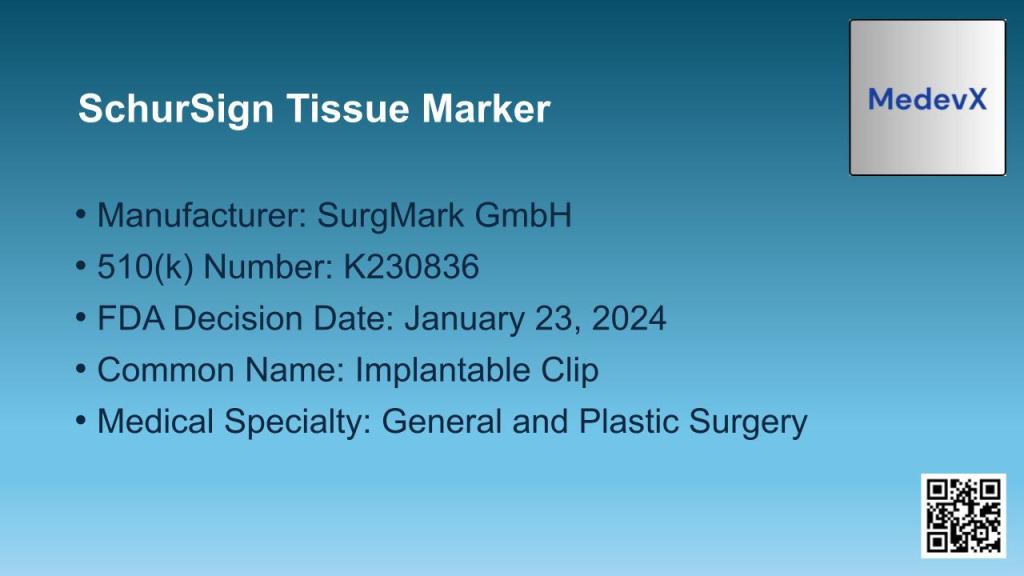
The SchurSign Tissue Marker consists of a radiographic marker and delivery system. It is sterile, single-use, and visible on standard radiographs, mammography, ultrasound, and MRI. The marker is chitosan filled with Barium Sulfate. The marker is placed into soft tissue during surgical or diagnostic procedures. It comes in various sizes, with markers ranging in diameter from 1.5 mm to 3.0 mm and lengths from 5 mm to 10 mm. The delivery system includes a 12 cm needle with depth marks designed to release the marker with a plunger system.
Indications
SchurSign is intended to mark soft tissues during surgical procedures for future identification.
Intended Use
This device is intended for use under the supervision of healthcare professionals. It is placed into soft tissues during procedures to mark areas for future surgical planning or follow-up.
Availability
- Use: Prescription only
Study Results
- An animal study on swine confirmed the marker’s effectiveness through X-ray and ultrasound imaging. Histopathology was conducted to ensure tissue compatibility.
- Nonclinical Testing: SchurSign underwent various tests, such as cytotoxicity, systemic toxicity, sensitization, and pyrogenicity, according to ISO standards. All tests confirmed the device’s safety and biocompatibility, with no new safety concerns raised.
Regulatory Information
- Regulation Number: 21 CFR 878.4300
- Regulatory Class: Class II
- Product Code: NEU
- 510(k) Number: K230836
The SchurSign Tissue Marker follows regulations for design controls, nonconforming products, and corrective actions. Manufacturing and labeling requirements align with FDA guidelines to ensure consistent safety.
Manufacturer Information
- Name: SurgMark GmbH
- Address: Maria-Louisen-Straße 122, D-22301 Hamburg, Germany
- Contact Person: Dr. Christine König
Predicate Device Information
- Primary Predicate: Beacon Tissue Marker (K130763), Scion Medical Technologies, LLC
The predicate device is similar in design and function. Both markers use barium sulfate as a radiographic agent, are sterilized using ethylene oxide, and utilize comparable delivery systems. SchurSign offers more size options and uses a different polymer material (chitosan).
Implications
SchurSign Tissue Marker allows precise marking of surgical sites for future reference, improving surgical planning and follow-ups. With equivalent performance to its predicate, it ensures seamless use across imaging modalities.
References
- SchurSign Tissue Marker. 510(k) Number K230836. SurgMark GmbH. FDA summary link. https://www.accessdata.fda.gov/scripts/cdrh/cfdocs/cfpmn/pmn.cfm?id=K230836
- https://www.surgmark.com/
 Medevx