
Device Information
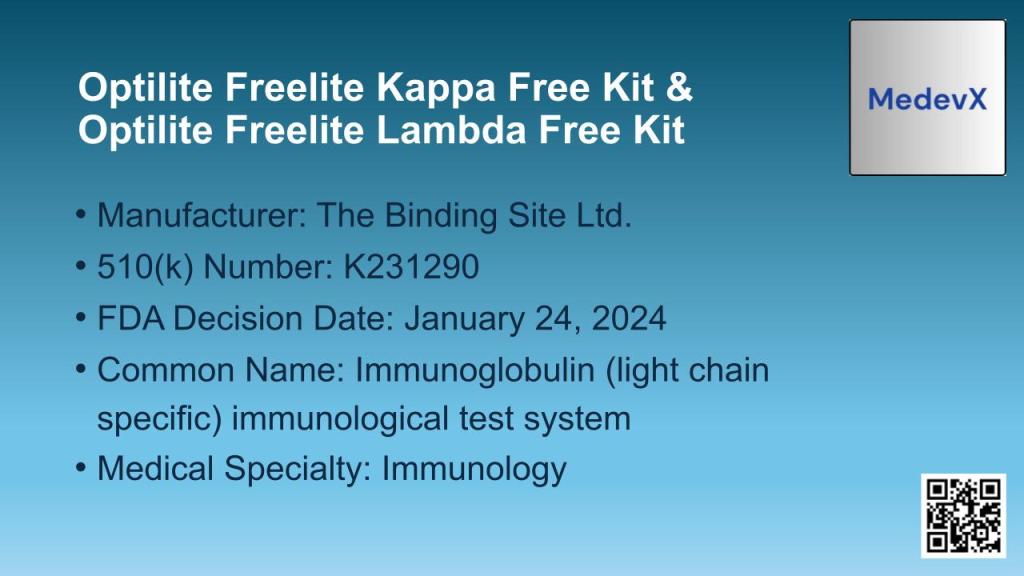
Device Specifications:
The Optilite Freelite Kits measure free light chains (FLCs) in serum. They use a quantitative, immunoturbidimetric method. The kits consist of reagents such as polyclonal monospecific antibodies coated onto polystyrene latex, calibrators, and controls. The operation is based on turbidimetry, where the concentration of FLCs is determined by the formation of immune complexes that scatter light. These assays are intended for use on the Binding Site Optilite analyzer.
Indications
The Optilite Freelite Kits are intended for the quantitative in vitro measurement of Kappa and Lambda free light chains in serum. The measurements aid in the diagnosis and monitoring of multiple myeloma, lymphocytic neoplasms, Waldenström’s macroglobulinemia, AL amyloidosis, light chain deposition disease, and connective tissue diseases such as systemic lupus erythematosus (SLE). They also aid in the evaluation of monoclonal gammopathy of undetermined significance (MGUS). Results should always be interpreted in conjunction with other laboratory and clinical findings.
Intended Use
These kits are intended for healthcare professionals to diagnose and monitor conditions like multiple myeloma, lymphocytic neoplasms, and related disorders in adult patients. The assays are designed for prescription use only and should not be used as a standalone diagnostic tool.
Availability
Prescription Use Only (Rx)
Limitations
- The performance has not been fully evaluated in all race/ethnicity groups.
- Patients with renal disease or inflammation may have elevated levels of FLCs, leading to potential misinterpretation.
- The performance of test in light chain MGUS patients has not been sufficiently studied.
- Unexpected results should be confirmed using an alternative assay method.
Study Results
Clinical Testing:
- A retrospective study included 234 samples from MGUS patients and 140 from non-MGUS patients. The sensitivity for detecting MGUS was 59.4%.
- A separate study of 49 MGUS patients evaluated stability and progression. The kit successfully differentiated between stable and progressive MGUS cases in 93.3% of stable patients and 50% of progressive patients.
Nonclinical Testing:
The Optilite Freelite Kits were evaluated using precision, linearity, and stability tests. They showed consistency in measuring the concentration of FLCs and the correct differentiation between kappa and lambda light chains.
Regulatory Information
- Regulation Number: 21 CFR 866.5550
- Regulatory Class: Class II
- Product Code: DFH, DEH
- 510(k) Number: K231290
- The kits are subject to general control provisions and labeling requirements per 21 CFR Part 801 and Part 809. The regulatory class requires compliance with quality systems (21 CFR Part 820).
Manufacturer Information
- Name: The Binding Site Ltd.
- Address: 8 Calthorpe Road, Edgbaston, Birmingham, B15 1QT, United Kingdom
- Contact Person: Jolanta Wolff, Regulatory Affairs Project Manager
Predicate Device Information
- Primary Predicate Device: Freelite Human Kappa Free Diagnostic Test Kit, K070900
- Secondary Predicate Device: Freelite Human Lambda Free Diagnostic Test Kit, K070900
- Differences: The Optilite Freelite Kits include an additional claim for evaluating MGUS, which is not present in the predicate devices. The primary technological difference is the extension of clinical claims without changes to safety or effectiveness.
Implications
The Optilite Freelite Kits provide a reliable method for evaluating multiple myeloma and related disorders. They offer enhanced capability to monitor MGUS and its progression to more serious conditions like multiple myeloma. This can help in early intervention and management.
References
- Optilite Freelite Kappa Free Kit. Optilite Freelite Lambda Free Kit. 510(k) Number: K231290. The Binding Site Ltd. FDA Summary. Linkhttps://www.accessdata.fda.gov/scripts/cdrh/cfdocs/cfpmn/pmn.cfm?id=K231290
- https://www.thermofisher.com/bindingsite/gb/en/home.html
 Medevx